

Nature Has Grains: What a Flock of Sheep Taught Me About the Grass-Fed Myth
- Morgan aka The Chatty Goat

- Jun 4
- 4 min read

Moving the flock to fresh grazing is one of my favorite jobs of the whole day. There's nothing like watching sheep pour through an open gate and tear straight into a new patch with their heads down, going for their favorites first. If you ever want a fast read on herd health, this is it. Five quiet minutes watching who eats eagerly, who hangs back, who's shouldering in for the best bite will tell you more than most charts. The animals are talking; you just have to stand still long enough to listen.
The other day I was doing exactly that when something obvious finally landed on me. They weren't working the whole grass plant evenly. They were ripping the seed heads off the top first — stripping out the grainy bit before anything else.
They were picking out the grain.
Nature has grains.
They're just packaged the way they're meant to be — balanced inside the rest of the plant.
The short version
Grain isn't the villain it's been made out to be. Ruminants seek out the energy-dense, grainy parts of plants entirely on their own — a seed head is nature's version of a scoop of feed. The real trouble comes from too much grain fed out of balance, or from the opposite mistake: chasing a "100% grass-fed" badge so hard that you end up with under-conditioned, grass-starved animals. We feed our dairy goats grain, in appropriate amounts, and we don't hide it.
"Grass-fed" got hijacked
We've all watched the grass-fed movement explode over the last few years. And like clockwork, Big Food grabbed the term and turned it into one more green word, right alongside "all-natural" and "pastured" — words that mean a little less every time somebody slaps them on a label to charge a little more.
Here's the part the marketing leaves out: feeding animals fully on grass, and doing it well, is genuinely hard. Done poorly, it doesn't give you a purer animal — it gives you a hungry one. Those calories have to come from somewhere, and a doe in heavy milk is running a serious energy budget. Pretend otherwise and the animal pays for it.
What's actually going on
The seed-head thing reframes the whole argument for me. Grain, in nature, isn't some separate, suspect thing sitting outside "real" forage. It's the energy-dense top of the very plant the animal is already grazing. The problem was never grain itself. The problem is balance, and quantity, and whether you're feeding the animal in front of you or feeding a marketing story. I don't believe grain is the issue, when it's fed in an appropriate quantity.
Exactly what we feed (no green words)
I'd rather show you than sell you a word, so here's our actual program.
Our sheep never get grain. May through November they're on pasture, full stop. They get our hay in winter, and during a summer drought when the grass can't keep up. The only supplement they ever see is the occasional pound of alfalfa pellets spread through the flock to help hold condition on the ewes in milk. That's it. No grain.
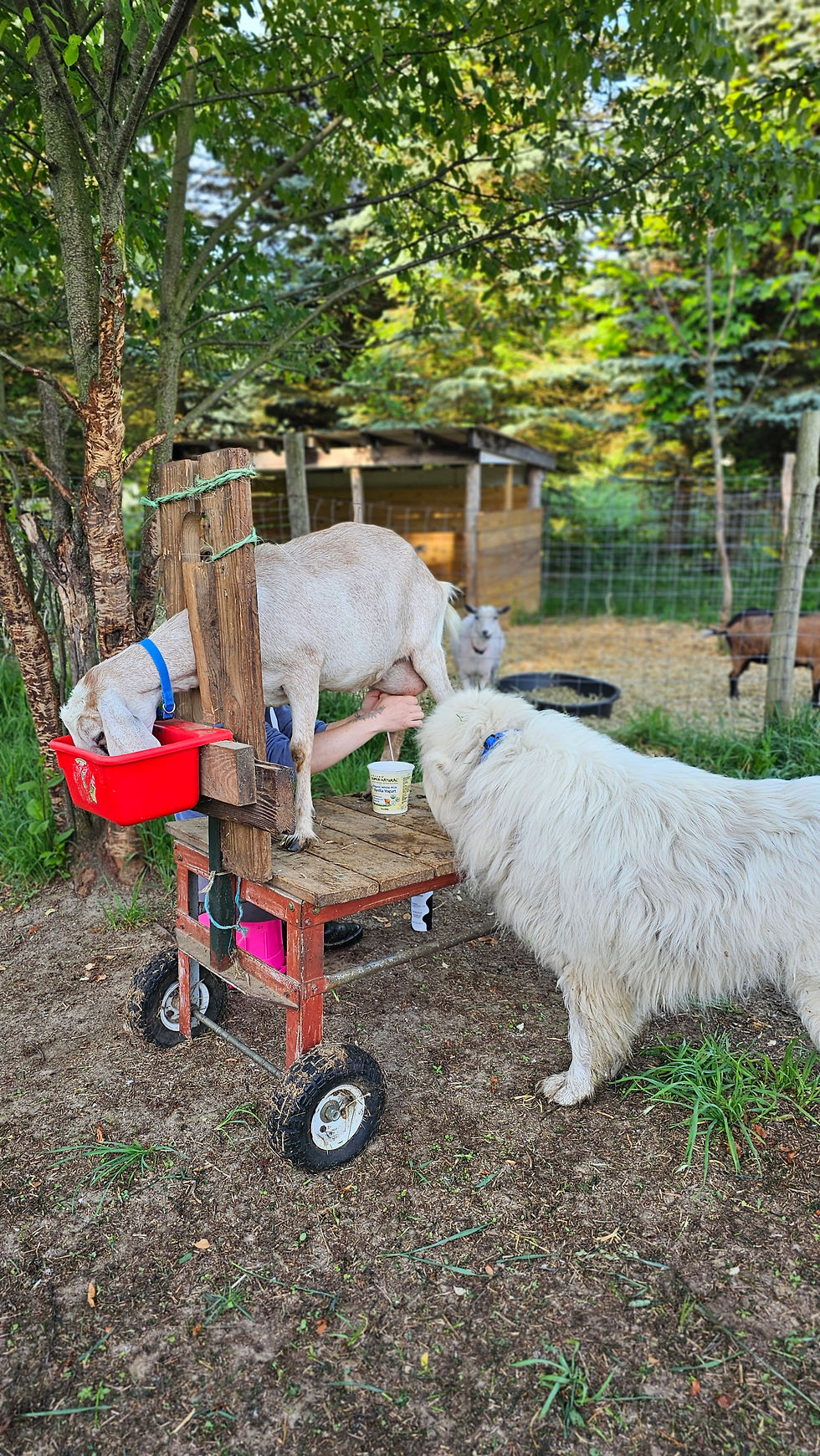
Our dairy goats are a different animal with different demands, and we feed them accordingly. On top of pasture, browse, and forage — plus the hay we make ourselves and the alfalfa hay we buy in — our milkers get grain on the stand. But the amount is matched to the goat in front of me, not to the back of a bag:
Our Nubians get 1 lb of grain while they're being milked, plus all the alfalfa pellets they care to eat.
Our Nigerian Dwarves get ½ lb of grain, plus the same free-choice pellets.
We milk once a day, so that's about a pound of grain a day for a Nubian milker and half a pound for a Nigerian Dwarf. Not a mountain. Just enough to hold proper condition while they're pouring milk into the pail.
That grain comes from Raub-Rae, a local organic mill in Brown City, Michigan, a couple hours from us. Organic, local, and milled by someone who knows what he's doing — we're lucky to have them.
The bottom line
Don't let a label do your thinking for you. "Grass-fed" can be a beautiful thing and it can be a marketing costume — sometimes on the same package. What actually matters is the animal's condition, the balance of the ration, and whether you genuinely know what's going into your stock. Grain, fed with intention, is a tool. Not a sin.
(I get into our whole feeding approach — and how to make it pencil out without starving your animals or your wallet — in my book.)
So, your turn: Do you feed grain to your ruminants?

Comments